
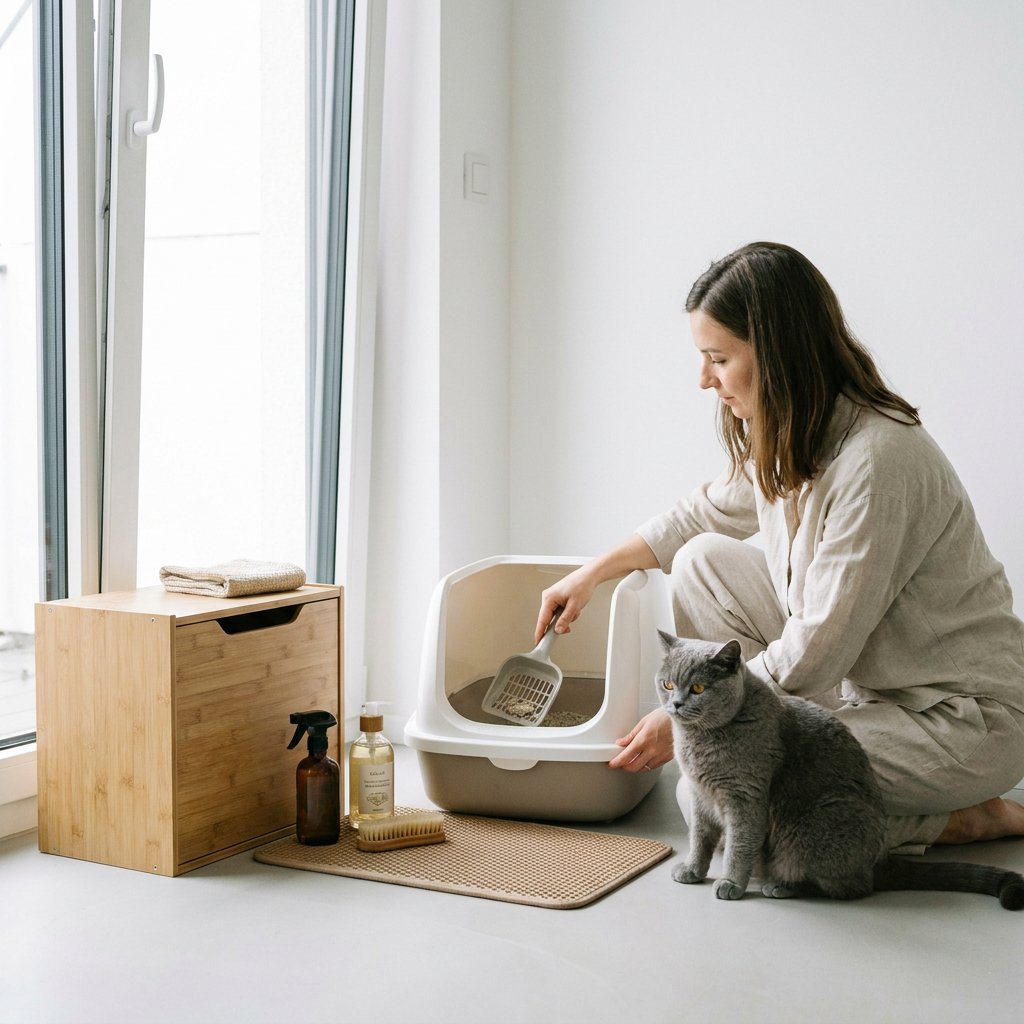
Cleaning a litter box is less about a miracle cure and more about routine. Scoop out clumps and waste daily, wash the box regularly, and replace the entire litter on time. This prevents urine from accumulating, odors from soaking into the box, and your cat from avoiding a dirty box.
What should you use to clean? In most cases, you will get far with warm water and a mild, unscented cleaning agent. If urine odor persists, an enzymatic cleaner for pets is often the smartest move. It is better to avoid strong agents like chlorine, bleach, and heavily scented additives. And even if you want to know why an automatic litter box primarily saves time, the fact remains that maintenance is required.
Why a litter box starts to smell so quickly
The odor usually does not come from the waste alone, but primarily from urine being broken down by bacteria into ammonia. On top of that, small residues remain in saturated litter, on the bottom, or along the sides of the box. That distinction is important: masking odors with a strong scent is different from removing the source. Litter can absorb moisture, but only frequent scooping, thorough washing, and if necessary, using an enzymatic cleaner truly tackles urine odor. If waste is left to sit or the bottom remains damp, a litter box can smell unpleasant within just a few hours.
How often you should scoop, wash, and perform a full change
- Daily: scoop out clumps and waste at least 1 to 2 times a day. The sooner you remove it, the less chance odors have to develop.
- Regularly: periodically wash the scoop, the rim, and visible dirt from the box with warm water and a mild agent.
- Full change: replace the entire litter depending on the type of litter, number of cats, and usage. For clumping litter, this is often every 2 to 4 weeks; for non-clumping litter, usually sooner, even if you choose a litter box without plastic bags. With litter box liners, you can make emptying faster and more hygienic.
- Always after washing: rinse the box well and let it dry completely before adding new litter.
Which cleaning agents are safe for your litter box?
Not every cleaning agent that is handy around the house is smart for a litter box. If you want to clean a litter box with bleach or chlorine, the short answer is: better not to.
| Agent | Suitable for | What to watch out for |
|---|---|---|
| Warm water | Daily or light cleaning of the box and scoop | Good for loose residues and freshening up, but less effective against ingrained urine odor |
| Mild, unscented cleaner or soap | Washing the box itself and removing greasy film | Use sparingly, rinse thoroughly, and let everything dry |
| Enzymatic pet cleaner | Persistent urine odor and dried-on residues | Follow the product's usage instructions; this tackles odors at the source better |
| Vinegar | Temporarily neutralizing light odors or limescale | Can smell distracting to some cats and does not truly dissolve urine deposits |
| Baking soda or carbon filter | Support for odor control | Only as a supplement; it does not replace scooping, washing, and refreshing |
| Chlorine, bleach, essential oils, strong perfume | Better to avoid | The scent is often too sharp, and you don't want residues left behind in a litter box |
If you do use an extra scent aid, keep it simple and mild. A fresh box does not start with perfume, but with a clean, dry base.
How to prevent the litter box from continuing to smell
- Scoop quickly: the less time waste is left to sit, the less odor builds up.
- Replace saturated litter on time: just topping it up does not help if the bottom layer is already full of urine.
- Keep the surrounding area clean: remove tracked-out granules and splatters; with litter box mats, you can catch track-out and clean and dry them regularly.
- Avoid strong scents: citrus, perfume, and other “fresh” scents smell pleasant to humans, but can actually deter cats.
- Take persistent stench seriously: it usually points to overdue cleaning, old litter, or residues that have remained in the box.
What makes cleaning easier: litter, box type, and location
Good cleaning starts with the right foundation. Clumping litter usually makes scooping faster, because urine forms compact clumps instead of sinking to the bottom. The right depth also helps: if there is too little litter in the box, urine sticks to the bottom more quickly. If there is too much, you scoop less neatly and are more likely to waste litter. Therefore, choose a type of litter that suits your cat and consistently keep the box at the right level. Optionally, choose dust-free cat litter to keep the area cleaner.
The type of box also makes a difference. An open litter box is often more accessible and easier to check visually. You can see immediately what needs to be removed and can clean the corners more easily. A closed model can dampen the odor experience in the room, but requires extra attention to the hood, rims, and any filters. More important than open or closed is often the size: a spacious box remains more practical to keep clean than a cramped model in which your cat has little room to move.
Additionally, pay attention to the design. Smooth surfaces, rounded corners, and parts that you can easily take apart save time when washing. The location also counts. Place the litter box in a quiet, easily accessible spot where your cat likes to go and where you can clean easily. In households with multiple cats, it also helps to have enough boxes so that one box does not become overburdened and get dirty faster.
A self-cleaning litter box saves work, but still requires maintenance
A self-cleaning litter box can make a big difference if you have multiple cats, are prone to odor problems, or find that daily scooping is difficult to maintain. Because clumps are automatically moved to a collection bin after use, waste is exposed for less time. This makes the routine more consistent and can considerably reduce manual work for those wondering: Never clean a litter box again?
At the same time, it is important to keep realistic expectations. Automatic cleaning does not mean you never have to clean again. You still need to empty the collection bin, wipe down the inside, and check that no residues are caking on the wall or at the bottom of the system. Granules, dust, and splatters can also remain around the entrance. In addition, use the type of litter that fits your litter box's system; the wrong granule size or too much dust often makes maintenance more difficult.
Maintenance points that are often forgotten are the collection drawer, moving parts, sensors, and any odor filter. You must clean or replace these according to the manual for your model. With the right routine, and replacement parts or accessories where necessary, you keep the system fresh and reliable. In this way, you get what automatic cleaning is best at: more convenience for you, with continued attention to comfort and hygiene for your cat.