
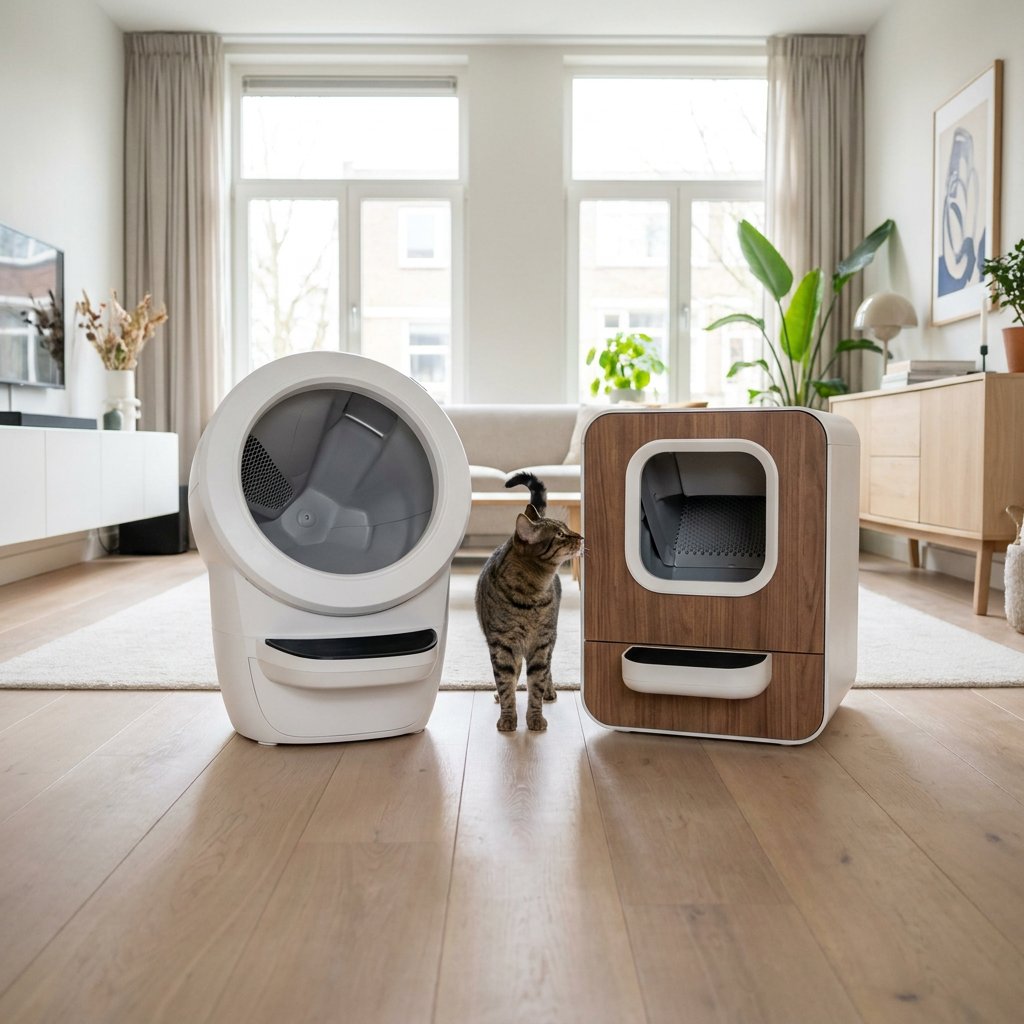
There is no single automatic litter box that is the right choice for everyone. Which automatic litter box is the best depends on your cat, the number of cats in your home, the space you have available, and whether you prefer an open or enclosed design. Your expectations also play a role: a self-cleaning litter box saves you from daily scooping, but emptying the waste drawer, topping up litter, and periodic cleaning remain necessary. Still in doubt? Best automatic litter box: our recommendations will help you get started quickly.
That is precisely why honest comparison is important. In practice, these points make the biggest difference: how the cleaning system works, how much usable interior space the box actually offers, how odor control is managed, how much maintenance is required, how safely the system reacts, which smart features are useful, how much noise you hear, and how reliable the model remains in the long term.
What differences do you really notice in daily use?
In practice, the PETLUX V3 is often compared to open premium models such as the Neakasa M1, more compact closed systems like some Poopy Cat models, and other top models in comparisons like Petlux V3 vs Litter-Robot 4. The table below primarily shows the practical differences, not just the features on paper.
| Model or segment | Cleaning type | Usable interior space | Opening | Waste capacity | Odor control | App | Noise | Power | Price segment | Best suited for |
|---|---|---|---|---|---|---|---|---|---|---|
| PETLUX V3 | Closed automatic system | Spacious | Spacious | Large | Good if the waste bin is emptied in time and components remain clean | Check current version | Moderate | Wall outlet | Premium | Larger cats, multiple cats, households wanting maximum convenience |
| Open premium alternative, such as the Neakasa M1 | Open automatic system | Often spacious | Very accessible | Medium to large | Depends on quick removal and a well-sealed waste bin | Often yes | Often moderate | Wall outlet | Premium | Cats that prefer an open design |
| Compact closed alternative, such as some Poopy Cat models | Closed automatic system | Average to compact | More compact | Medium | Closed construction often helps, but you will notice a full bin faster | Often yes | Quiet to moderate | Wall outlet | Mid-range to premium | Single cat, smaller living space, those wanting compact |
| Simpler rake or sliding system | Rake or slider | Often more compact | Varies | Small to medium | More dependent on frequent emptying and cleaning | Sometimes, often not | More mechanical | Wall outlet or battery, model dependent | Lower to mid-range | Basic automation, people who prefer not to use an app |
You notice this in comparisons like Petlux V3 vs PETKIT Pura X/Purobot: premium models more often win in terms of quietness, sensors, and ease of use. Simpler systems are often more affordable but usually require more manual work. Two boxes may look similar on paper, while in practice the real differences lie in the entry, turning space, how often you have to empty the waste bin, and how easy a deep clean is. Want to see models, prices, and stock side-by-side? View all automatic litter boxes.
How automatic litter box cleaning works
Most automatic litter boxes work with a rotating system or a rake or sliding mechanism. After a cat uses the litter box, the unit waits a short time to allow the clumps to form properly. Then, the system separates the waste from the usable litter. With a rotating system, the drum moves so that clumps and waste go into a waste bin, while clean litter falls back. In a rake or sliding system, a mechanical part pushes the waste into a drawer, leaving the clean litter behind.
Modern models only clean after the cat has left the box. This is important for safety, quiet, and odor reduction. At the same time, the chosen system influences everything else: which litter works best, how much noise you hear during a cycle, and how easy the box is to clean thoroughly later on. The technology is therefore not a minor detail, but determines a large part of the daily user experience.
For whom is an automatic litter box smart - and what are the drawbacks?
An automatic litter box is particularly interesting if your current daily routine takes up a lot of time. However, it is not automatically the best solution for every household. Look objectively at both the advantages and the limitations.
- It is often a good fit for busy households where you want to scoop less frequently while maintaining a cleaner box between cleaning sessions.
- For multiple cats, automatic cleaning can make a big difference because the box is usable again sooner, and you get less waste accumulation.
- For people sensitive to odors or simply wanting more convenience, this type of box is often a logical step.
- If you are away from home for short periods, an automatic box can provide extra peace of mind, but it is not a substitute for supervision or leaving it completely unattended for long durations.
- The higher purchase price is a definite disadvantage. You are paying not just for the box, but for technology, sensors, and sometimes consumables.
- You remain dependent on electricity and regular maintenance. Automatic does not mean maintenance-free.
- In practice, you still need to empty the waste bin, top up the litter, wipe down parts, and periodically clean the box entirely.
- Not every cat immediately gets used to movement or noise. Letting them get used to it gradually, with a familiar, standard box nearby, is often the best approach.
Size, entry, and open or closed: how to choose what fits your cat
When choosing an automatic litter box, external dimensions do not tell the whole story. Much more important are the usable interior space, the height of the entry, and the size of the opening. A box may look large but feel relatively cramped on the inside. This makes a big difference for automatic models, as a cat needs enough space to turn around, dig, and exit in a relaxed manner.
Large cat breeds naturally benefit from this, but even smaller cats often prefer more space than you might expect. Open designs feel more accessible and are sometimes accepted more quickly by cats. Enclosed designs offer more privacy and can help with odor control, but not every cat enjoys a more compact entrance. With multiple cats, you look not only at the space inside the box but also at the waste capacity and how much time there is between emptying intervals. Still in doubt about the right size? Which size litter box fits your cat?
Maintenance, odor, and litter determine daily convenience
Odor control depends on more than just a filter. Equally important are how quickly waste is disposed of, how well the waste bin is sealed, and how consistently you clean or replace components. A model might be technically smart, but if waste sits for too long or the bin fills up quickly, you will notice it immediately in your home.
For most automatic systems, clumping litter is the safest base, as the system relies on firm clumping. Wood pellets or silica do not work well with every model, so always follow the product specifications of your box. In daily use, the same tasks return: emptying the waste bin, topping up litter, refreshing everything occasionally, and keeping sensors or moving parts clean. Also, pay attention to the design itself. An empty or dump function, removable parts, and water-resistant components often make deep cleaning much easier. In the long term, it also helps if consumables and replacement parts remain readily available.
Check safety and reliability before looking at the extras
A reliable automatic litter box has multiple sensors and a clear stop function, so that a cleaning cycle interrupts or does not start when it is not safe. However, safety is not just found in the list of features. The quality of the design, the build, and the predictability of the system in daily use also count. Do you want to know exactly what to look for? How to choose a safe automatic litter box.
Placement is also important. Models with weight detection work most reliably on a hard, level surface, not on a soft mat or uneven floor. Also, look beyond the initial purchase for the long term: are spare parts available, is there installation support, and can you get service or repairs? That makes a big difference in practice.
Which extra features are actually useful?
Extra features are only valuable if they truly simplify your routine. An app is mainly useful if you use it in daily life, for example, for notifications about cleaning status, a nearly full bin, or settings for cleaning delays. A long list of features sounds nice, but adds little if you don't actually use them.
Usage statistics and weight tracking can help monitor patterns and notice changes sooner. However, such data is only useful if the measurements are stable and consistent. View it as extra insight, not a diagnosis or a substitute for your own observation. For many households, noise is even more important than app features. If the box is in the living room or operates at night, a quieter model may be more pleasant than one with more digital extras. Don't forget the prerequisites: smart models require a power outlet, and app functions only work well with a stable Wi-Fi setup.
Tests and model versions: how to avoid comparing old information
Comparisons of automatic litter boxes age quickly. New generations are released, specifications change, and app functions are updated while old reviews remain online. Therefore, always check the exact model number, the generation, the publication date, and what comes as standard. Independent tests are useful as an extra check. But they only help if they measure your situation. The same applies to version differences, such as Nano 2 versus 3: a higher version number only says something if the opening, interior space, sensors, bin, noise, maintenance, and software are demonstrably different.